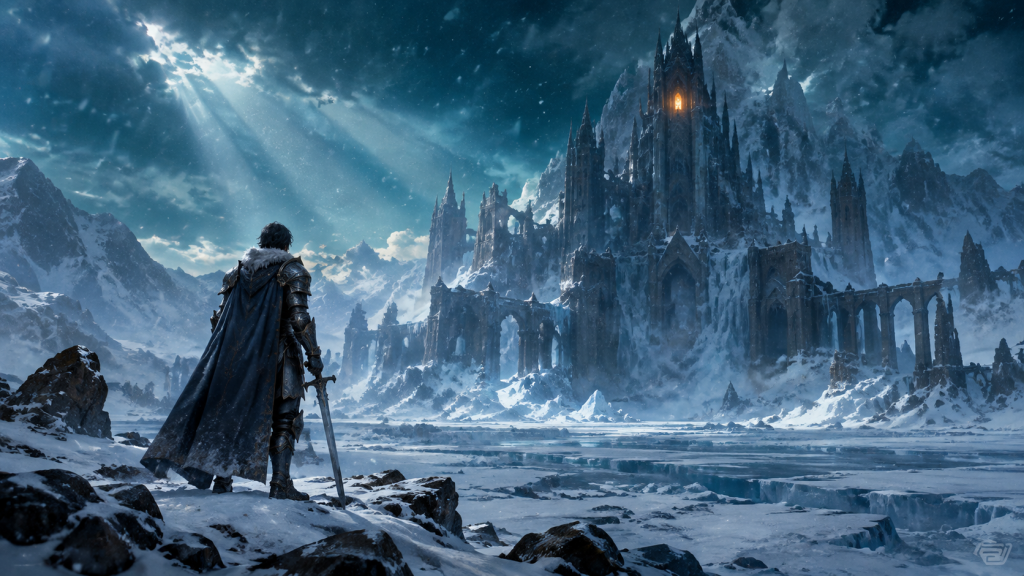
It's not on Battle.net. It never updates. And on any given Tuesday night, roughly 100,000 people are still killing the Lich King inside it.
The server that refuses to leave 2010
If you heard the name WoW Forever for the first time today, you'd reasonably assume it was a Blizzard marketing stunt. An anniversary rebrand. Some kind of seasonal "Classic Plus" tease.
It isn't.
WoW Forever is a community-run World of Warcraft private server that has, by design, frozen the game at patch 3.3.5a — Wrath of the Lich King — and refused to move forward. No new expansions. No "modernizations." No battle.net launcher. No 90-second login. You download a client from a forum thread, pick a realm, type in a credit card through a sketchy-looking checkout page, and you're standing in Northrend, in the year 2010, with the same 25-man ICC rosters your guild lead was running fifteen years ago.
The promise is breathtakingly simple: the world you log into today is the world you'll log into next year, and the year after that.
That promise is also, almost exactly, the thing that almost no legitimate publisher in the game industry is willing to offer in 2026.
Why Blizzard's own WotLK Classic shutdown actually made this thrive
In late 2025, Blizzard quietly started the wind-down of several classic-era realms, including the WotLK Classic cluster, folding the remaining population into the new "Classic Catalyst" seasonal format. The company's public reasoning was the kind of language a finance reporter would recognize before a gamer would: engagement curves are flat, the audience is consolidating, we need to deploy engineering resources toward current projects.
Translated: these old servers aren't making the next quarterly call any more interesting.
You'd expect that to be the obituary for old-school WoW. Instead, WoW Forever's concurrent player count went up in the two months following the announcement.
This sounds backwards until you remember how human memory works. The moment a corporation formally declares an era over, that era becomes emotionally load-bearing. Anyone who wanted to keep playing WotLK — for the raids, the PvP ladders, the friendships from college, or just the aesthetic of frozen Northrend — suddenly had a single, urgent question:
If Blizzard isn't going to keep this version alive, who is?
The answer, for a chunky slice of the global player base, was "we are."
These projects are essentially community-built history museums with a monthly subscription fee. When the official custodian announces a wing is closing, the volunteers who love that wing don't riot — they set up their own climate-controlled room down the street. That's what WoW Forever has been doing, quietly, for almost a decade.
What the actual player experience looks like (no filter)
Let's walk past the marketing copy.
After a decade of operation, any surviving private server accumulates a thick layer of stuff nobody put in the manual — bugs that became features, workarounds that became culture, moderation habits that became folklore. WoW Forever is no exception.
The player base is old. Like, really old.
The median WoW Forever player is in their mid-thirties. They were in college when ICC was current. Many now have kids. Many now have knee problems. A non-trivial slice of active raiders log in between 11 PM and 3 AM local time, after the toddler is asleep and the laptop is plugged in next to a baby monitor.
New players are technically welcome. In practice, the social contract assumes you already remember how spell hit rating worked in 2009. There's no tutorial. There are no boosted characters handed out for the holidays. If you don't know what "spell power on weapons" means, you're going to be politely ignored for a while.
Money is honest-ish, but it is money
The actual revenue model is more transparent than some indie studios:
- A monthly sub, typically $5–$15 depending on the tier
- Paid services: character transfers, name changes, cosmetic mounts
- A handful of sponsored PvP tournaments with prize pools
There are no loot boxes. There is no NFT nonsense. But there is the ever-present fact that you're paying a private entity in a jurisdiction you don't live in, with no consumer protection, and your account can theoretically disappear if the project gets a cease-and-desist letter. Most players shrug at this. Some of them have been bitten by it once already on a different server that doesn't exist any more.
Cheating: the part nobody wants to fix properly
Botting in BGs is the chronic illness of every long-running WoW private server. The anti-cheat on WoW Forever is, charitably, community-grade. It catches the dumb bots. It does not catch the smart ones. And because the GMs are themselves longtime players from the same Discord, the moderation has a very specific texture: strict on the easy cases, suspiciously slow on the awkward ones where the offender has buddies on staff.
This isn't scandalous. It's just what happens when you try to operate a 2010-vintage game using 2026-era social dynamics and a budget the size of a medium-sized Discord server's Patreon.
A brutally honest comparison table
If you're on the fence, this is the only chart you actually need:
| Dimension | WoW Forever | Official WotLK Classic (now shutdown) |
|---|---|---|
| Patch version | Permanently 3.3.5a, no plans to change | Folded into seasonal Catalyst formats, content rotated |
| Monthly cost | $5–$15 | $14.99 USD |
| Server uptime | Good weeks, bad weeks, occasional weekends of pain | Blizzard-grade |
| Community vibe | Old-guard raiders, very inside jokes, slow to onboard | Mixed crowd, high traffic, faster turnover |
| Anti-cheat | Volunteer-grade, lopsided | Industrial |
| Account safety | Zero legal recourse if it goes down | Full consumer protection |
| Long-term roadmap | None — that's the point | Continually evolving, never settling |
The one-sentence version: WoW Forever wins on purity and price. It loses on stability and safety. If you want to relive a specific memory, it's the highest-fidelity option still standing. If you want a future, this isn't that.
The bigger question nobody wants to ask in public
Step back from the game for a second.
When a commercial company decides to shut down a version of its own product, do players have a right to keep that version alive?
In the analog world — books, films, music, architecture — the answer is obviously yes. Museums exist. Archives exist. Fan restorations of dead films exist. We don't sue the Library of Congress for having a 1923 print of Ten Commandments because Disney owns the IP.
In games, this question is still legally unsettled and culturally weird. Major publishers have not formally endorsed any long-term private server project in the West. They have, very quietly, decided that as long as one is small, foreign-based, doesn't aggressively advertise, and doesn't break into the press, it's cheaper to leave it alone than to litigate it into dust.
WoW Forever has existed for years precisely inside that don't-ask-don't-tell gap.
That makes it legally fragile, even when it's socially uncontroversial.
The closest thing gaming has to an unauthorized archive
Take the cynicism out for a moment.
There aren't many software products in the world that get a second life of this length, on this scale, with this much continuity, after the original company has decided to move on. When IBM stopped selling a model of mainframe, hobbyists didn't build a global emulator. When Quake 3's official servers went dark, nobody stood up a faithful reconstruction that still gets 100,000 nightly logins a decade later.
MMOs are uniquely suited to this, because they are uniquely communal. The thing people stay for isn't the engine — it's the people they queued with. WoW Forever is, in the end, less a private server than it is a distributed agreement among a few hundred thousand strangers to keep meeting in the same fictional place on Tuesday nights.
That's not a clever tagline. It is, by a wide margin, the most accurate description of the project I've been able to write after spending several months reading the forums.
Practical notes if you decide to try it
If you've read this far and something is itching — three pieces of advice from people who've been there:
- Set a hard budget, and treat the money as entertainment spend, not investment. When (not if) a server you love eventually closes, you don't get a refund, and you don't get closure.
- Don't come in expecting to "finish" anything. There is no end state. There is only "tonight's raid." That's the whole pitch.
- Bring a friend, or be ready to grind alone for a while. Solo-friendly content exists, but the social fabric assumes you have at least one anchor connection already.
And one prediction, with about as much confidence as anyone has in this scene:
The version of World of Warcraft that survives longest into the 2030s will not be the one Blizzard is still selling. It will be the one Blizzard quietly decided was no longer worth selling — kept warm by people who loved it before it was ever a quarterly earnings line.
If you want to see what that looks like, WoW Forever is still up.
No one knows for how much longer.
That's the part that makes it a story.